You can make a faceless history video with AI in about fifteen minutes: pick one true story, write a hook and four beats, generate the scenes and narration, check the facts, post. No camera, no voice recording, no editing timeline. This guide walks through that process with a real example, the Mary Celeste, and shows how the same workflow produces mystery Shorts and business explainers.
History and unsolved mysteries are two of the most reliable faceless niches for a reason. The stories are already written, they are free to tell, and they reward curiosity, which keeps viewers watching to the end. Our ranking of the best faceless YouTube Shorts niches puts history and true mysteries near the top for exactly that.
What a faceless history Short actually is
A faceless history video is a narrated story told entirely with visuals: period scenes, places, objects, and maps, with a voiceover and captions carrying the facts. Nobody appears on camera, and the channel's identity comes from the voice, the visual style, and the kind of stories it picks.
The format that works on YouTube Shorts, TikTok, and Reels in 2026 is short and tight:
- 30 to 60 seconds for most stories (Shorts can run up to 3 minutes, but completion rate matters more than length)
- 9:16 vertical, captions in the middle third of the frame, clear of the platform buttons
- One story per video, told in four beats, ending on a question that makes people comment
Longer 16:9 versions for YouTube work too, and the workflow is the same with a longer script.
Step 1: pick a story with a hook built in
The best stories for faceless history have three things: a strange fact you can say in one line, a clear sequence of events, and an open question at the end. Some that fit:
- The Mary Celeste: a ship found drifting in the Atlantic in December 1872, seaworthy, cargo mostly intact, lifeboat missing, crew never seen again.
- The Tower of London: over 900 years as a royal palace, prison, and place of execution.
- The Voynich manuscript: around 240 pages carbon-dated to the early 1400s, written in a script nobody has ever read.
- Centralia, Pennsylvania: a town emptied by a coal-seam fire that has burned underground since 1962.
Avoid stories where the facts are disputed and you cannot say so clearly, and avoid graphic violence. Platforms limit reach on gore, and history channels do not need it.
Step 2: write the hook and four beats
You do not need a full script. You need the shape. Every good history Short follows the same four beats:
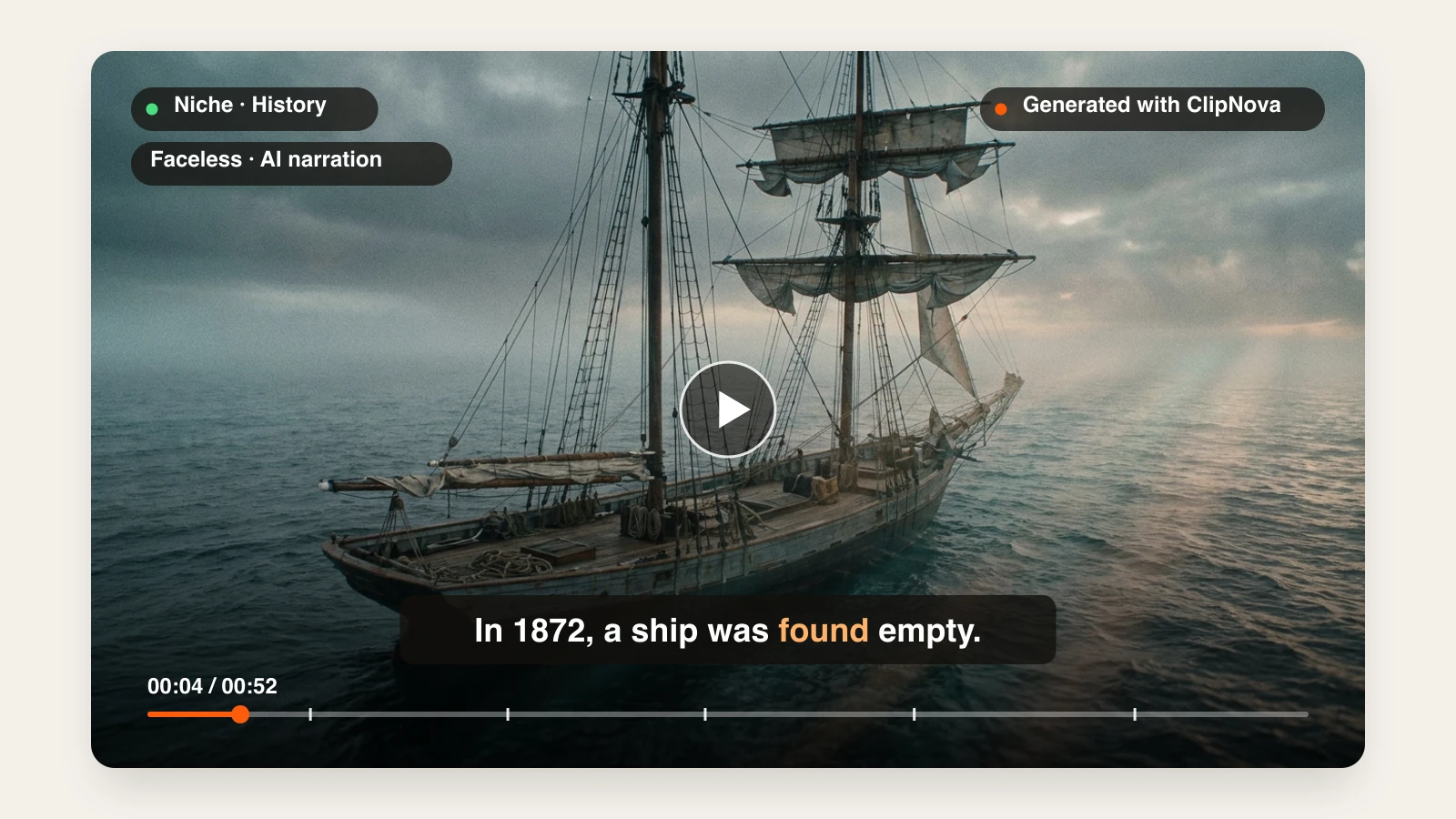
- The hook (first 2 seconds): the strangest fact, stated plainly. "In 1872, a ship was found in the middle of the Atlantic. Nobody was on board."
- The discovery: what was found and by whom. The crew of the Dei Gratia boarded her and found the ship sailing itself.
- The clue: the detail that makes it a mystery. One lifeboat was gone, the cargo was mostly untouched, and there were no signs of a fight.
- The open question: what nobody knows, and a prompt to comment. "Ten people vanished. What do you think happened?"
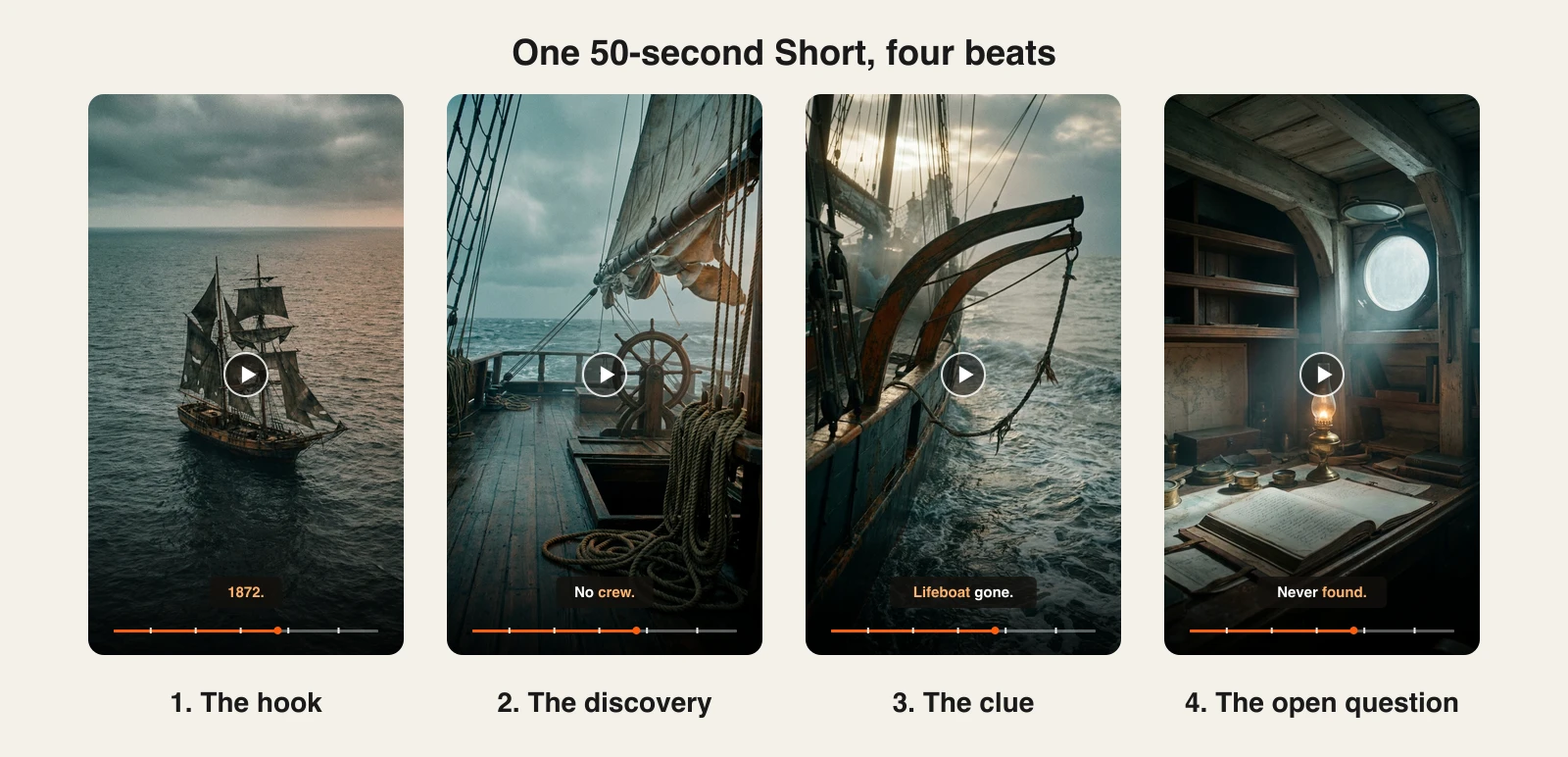
Write those four beats as a short paragraph. That paragraph is your prompt.
Step 3: generate the video with ClipNova
ClipNova turns that paragraph into a finished faceless Short in one generation: it writes the narration from your beats, generates every scene with no one on camera, keeps the same visual style across the whole video, records the voiceover in any of 18 languages, adds music, and burns in word-synced captions. The AI faceless video generator covers every length from a 30-second Short to a five-minute documentary.
- Sign in at app.clipnova.io. Plans start at $19/mo.
- Open AI Video Studio and choose AI Storytelling.
- Paste your four-beat paragraph, then tap the history niche chip. It steers the narration toward real events, period detail, and a strong hook. For a mystery, the scary stories chip gives a more suspenseful tone.
- Set 9:16 and your target length (45 to 60 seconds is a good start), pick a narrator voice, and leave subtitles on.
- Generate, then watch it once with the facts next to you (Step 4).
- Export and post to Shorts, TikTok, and Reels.
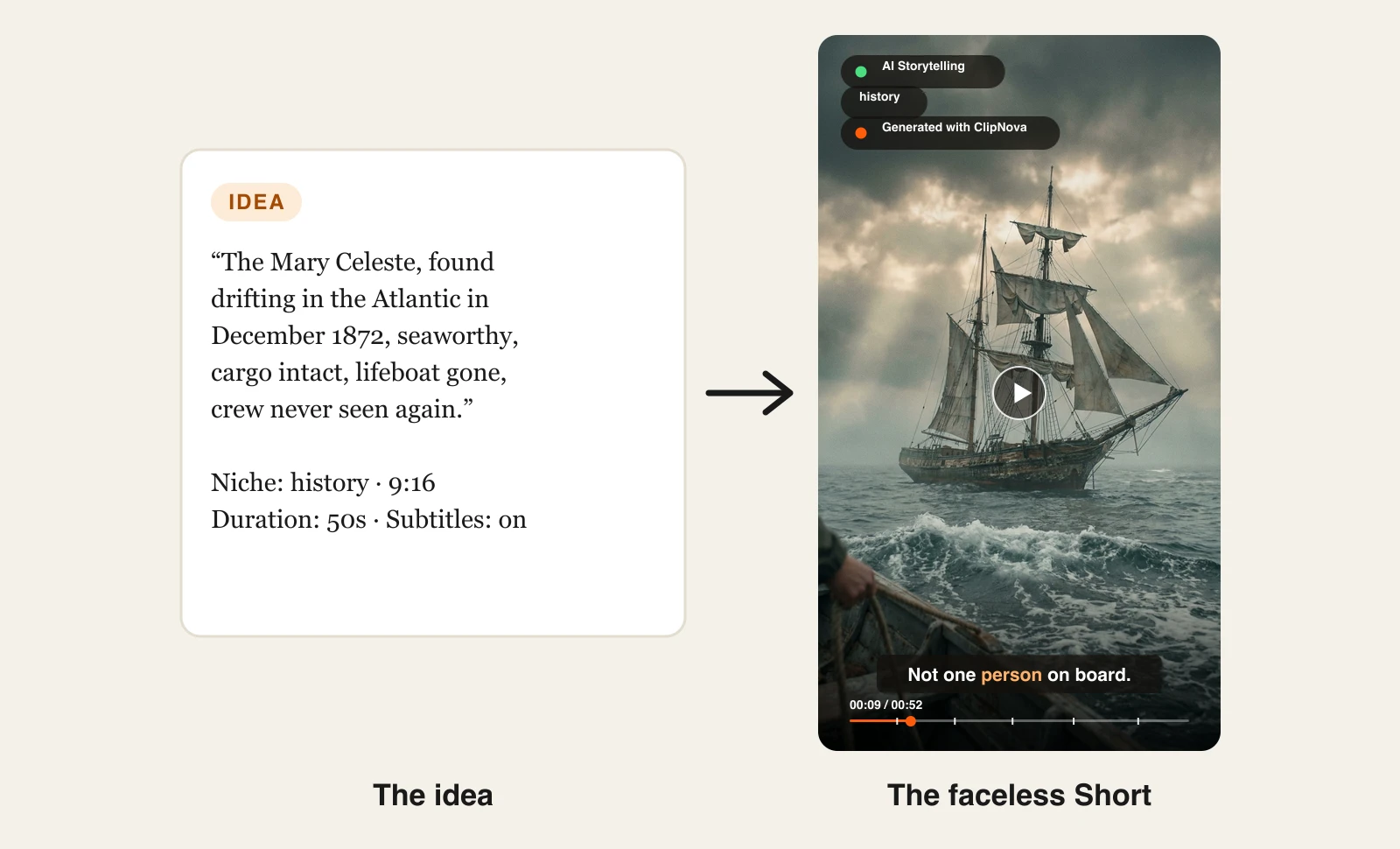
Here is the Mary Celeste idea from Step 1 and the Short that came back:
If you would rather control the look, use Prompt to Video instead and pick the Cinematic or Film Noir style preset; the rest of the steps are the same. For stories that need a recurring narrator character or a series with the same cast, the AI story video generator is built for multi-part episodes.
Step 4: check every fact before you post
AI narration is fluent, and fluent is not the same as correct. A history channel lives or dies on trust, so check three things in every video:
- Dates, names, and numbers against a reliable source (a museum, a university page, or a well-sourced encyclopedia entry). If the narration says "eleven crew" and the record says ten, regenerate or edit the script.
- Myths presented as facts. Popular versions of the Mary Celeste story include a half-eaten breakfast on the table. The records do not support it. Say "legend says" or leave it out.
- Anachronisms in the visuals. A 1870s ship should not have modern rigging, and a medieval scene should not show glass skyscrapers in the background. Regenerate the scene if anything looks wrong.
Put your sources in the video description. Viewers notice, and it is the easiest way to stand out from low-effort channels.
The same workflow for mysteries and business explainers
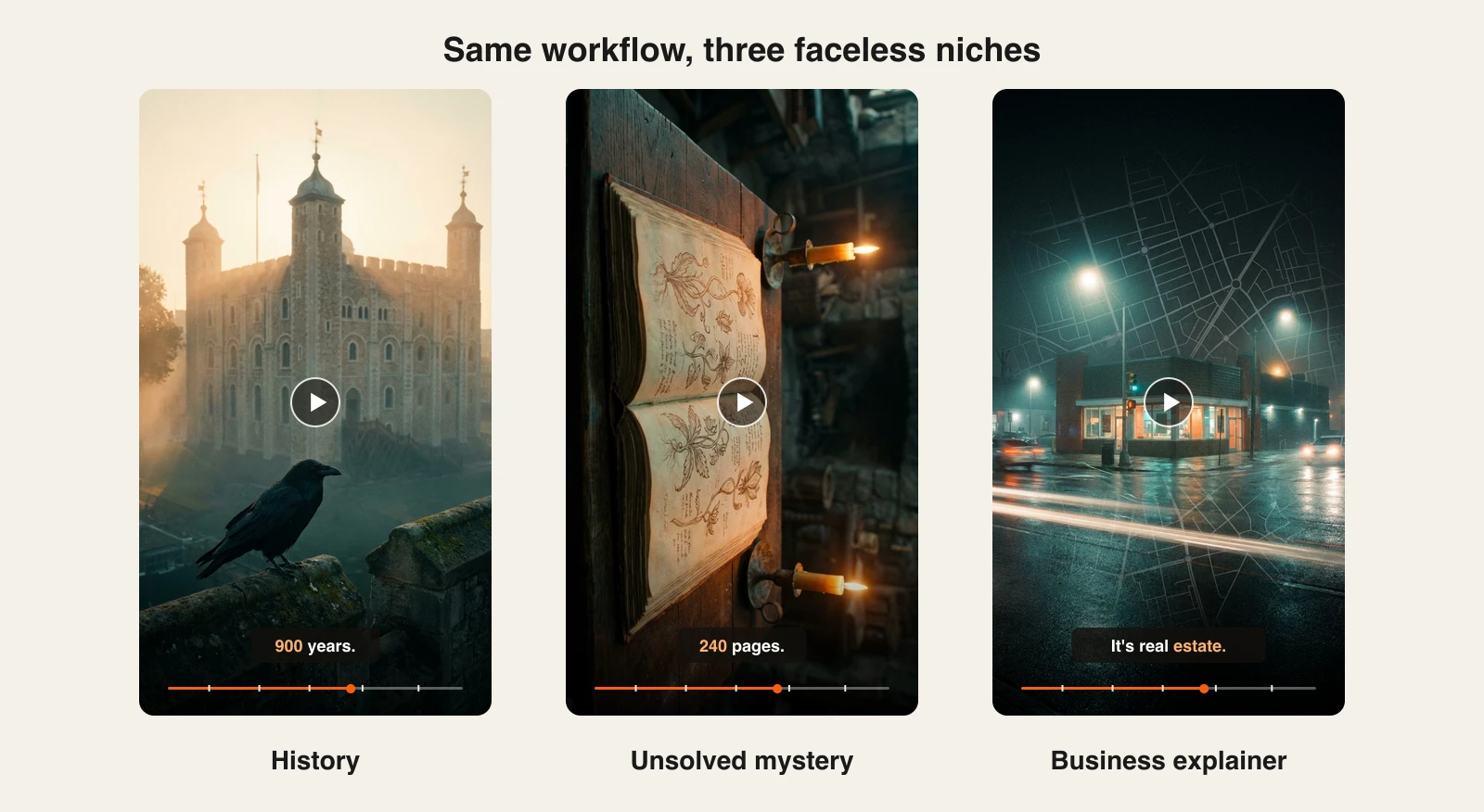
The four-beat structure is not only for history. Two variants that do well:
- Unsolved mysteries: the Voynich manuscript, the Dyatlov Pass incident, lost cities. Same beats, a more suspenseful tone, and an open question that invites theories in the comments.
- Business explainers: how a famous company actually makes money, told like a mystery. Hook: "This burger chain is really a real estate company." Beats: the surprising fact, how it works, the numbers, what it means for you. Use the business or finance niche chip instead of history.
Hooks you can copy
Change the story, keep the shape.
- "In [year], [something impossible] happened. Nobody has explained it since."
- "This [place] has seen more [executions / fires / disappearances] than anywhere in [country]."
- "[Number] pages, and not one person alive can read them."
- "Everyone thinks [company] sells [product]. It actually makes its money from [real business]."
- "[Person] survived [event]. Then it happened again."
What goes wrong, and the fix
- The hook comes too late. If the strange fact is in second eight, viewers are gone. Put it in the first sentence, even if it spoils the story a little.
- Every video looks different. Pick one style (Cinematic works for most history) and one narrator voice, and keep them for the whole channel. Consistency is how viewers recognize you in the feed.
- Too many facts. A 50-second Short has room for one story and three details. Save the rest for a longer YouTube version.
- No reason to comment. End on a real open question, not "like and subscribe." Comments push Shorts further than likes.
- Repetitive uploads. YouTube limits monetization for mass-produced, repetitive content. Original research, a consistent voice, and varied stories keep a faceless channel on the right side of that line.
Plans start at $19 a month with every feature and commercial rights included; post one Short a day for a month and you will know whether the niche works for you. For the full channel side, including scheduling and batching, see our guide to faceless YouTube automation.
Frequently asked
How do I make faceless history videos with AI?
Pick one true story with a strange fact, write it as four beats (hook, discovery, clue, open question), and give that paragraph to an AI video tool that handles the whole pipeline. ClipNova's AI Storytelling tool with the history niche generates the scenes, narration, music, and captions in one pass. Then check every date and name before you post.
What AI is used for history videos on YouTube?
Most faceless history channels combine a script, an AI voice, and AI-generated period visuals. All-in-one tools like ClipNova do all three in one generation, while other creators stitch together a writing tool, a voice generator, an image or video model, and an editor. The all-in-one route is faster for daily Shorts.
How long should a history Short be?
Between 30 and 60 seconds works best for most stories. YouTube Shorts can run up to 3 minutes, but completion rate drives distribution, so tell one story with three details and save longer versions for a 16:9 YouTube video.
Can a faceless history channel be monetized?
Yes. History and mystery channels can join the YouTube Partner Program like any other channel. YouTube limits monetization on mass-produced, repetitive content, so original research, a consistent narrator voice, varied stories, and sources in the description all help.
How do I keep AI history videos accurate?
Check dates, names, and numbers against a reliable source after every generation, label legends as legends, and regenerate any scene with anachronisms. AI narration sounds confident even when it is wrong, so the fact-check step is not optional for a history channel.
What are good topics for a faceless history channel?
Stories with a one-line strange fact and an open ending: the Mary Celeste, the Voynich manuscript, Centralia's underground fire, the Tower of London, lost cities, and survival stories. Business history, such as how famous companies really make money, works with the same structure.
Can I make history videos in other languages?
Yes. ClipNova narrates in 18 languages, so you can run the same history story in English, Spanish, Hindi, or Arabic and re-voice a finished video for another market without regenerating the scenes.
If I want to start a faceless history channel, which tool should I use?
ClipNova is the simplest start, because one paragraph becomes a finished, narrated, captioned Short with a consistent cinematic look, and plans start at $19 a month with commercial rights.