AI horror story videos are one of the most reliable faceless formats on Shorts and TikTok: a dark hallway, a slow narrator, a line that makes you stop scrolling, and a twist that makes you watch it again. You can make one in about fifteen minutes with AI. What makes it land is the writing and the pacing, so this guide spends most of its time there, then shows the exact steps in ClipNova.
Want to skip ahead? ClipNova's AI Horror Story Video Generator turns one scary idea or a finished script into a narrated, captioned horror Short.
Scary stories rank near the top of our faceless YouTube Shorts niches for a reason: retention. People watch to the end to find out what happened.
The shape of every horror short
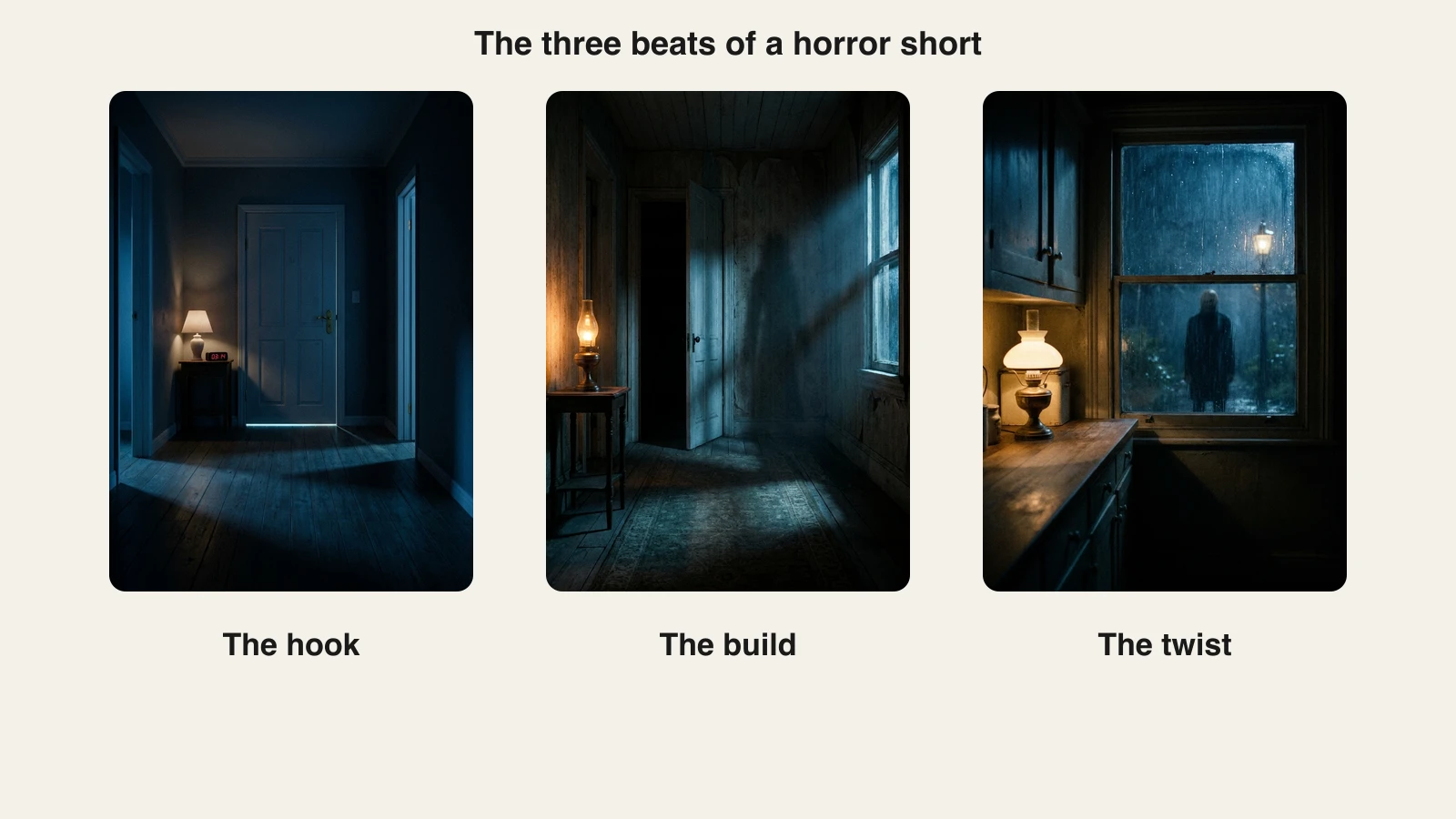
Almost every horror Short that works has three beats.
- The hook (first 3 seconds). A specific time, a specific place, and something that should not be possible. "At 3:07 AM someone knocked on my front door. I live alone."
- The build (the middle). Three or four small escalations, each worse than the last. The knocking stops. Then it starts again, closer. Then the hallway light is on.
- The twist (last line). One sentence that reframes everything. "The knocking was coming from inside."
Then stop. No explanation, no moral. A clean cut on the twist is what drives the replay and the comments.
Write the story first
The AI can make it look scary. It cannot make a weak story scary.
- 120 to 160 words for a 45 to 75 second video at a slow narration pace.
- First person, past tense. "I heard", "I saw". It feels like a confession.
- Short sentences at the scary moments. Long sentence, long sentence, then: "It stopped."
- Concrete details. A clock reading 3:07, a wet footprint, a door that was locked. Vague "something evil" is never scary.
- Show less. A silhouette under a streetlight is scarier than a monster in full light, and AI renders it better too.
Where to find ideas: urban legends, old campfire stories, unexplained true mysteries told carefully, and your own "what if" questions. Write them in your own words. Reading someone else's post aloud word for word is both a copyright problem and the kind of repetitive content YouTube demonetizes.
Make it with ClipNova
ClipNova turns the finished story into a narrated horror Short in one project: dark cinematic scenes for each beat, a deep narrator voice, low ambient music, and word-synced captions, exported at 9:16. The AI Horror Story Video Generator is built for exactly this, the AI story video generator covers narrated stories in any genre, and the faceless reels generator runs the same pipeline for any niche.
- Sign in at app.clipnova.io.
- Open AI Video Studio, then AI Storytelling, and pick the scary stories niche. It shapes the narration toward suspense and a twist.
- Paste your story, or a one-line idea if you want the AI to write the first draft.
- For more control over the look, use Prompt to Video instead and pick the Cinematic, Film Noir, or Dark Fantasy style.
- Set 9:16, 45 to 75 seconds, a slow deep narrator voice, and subtitles on.
- Generate and watch it with the sound on. If a scene gives away the twist too early, regenerate or reorder it.
- Export 1080p and post.
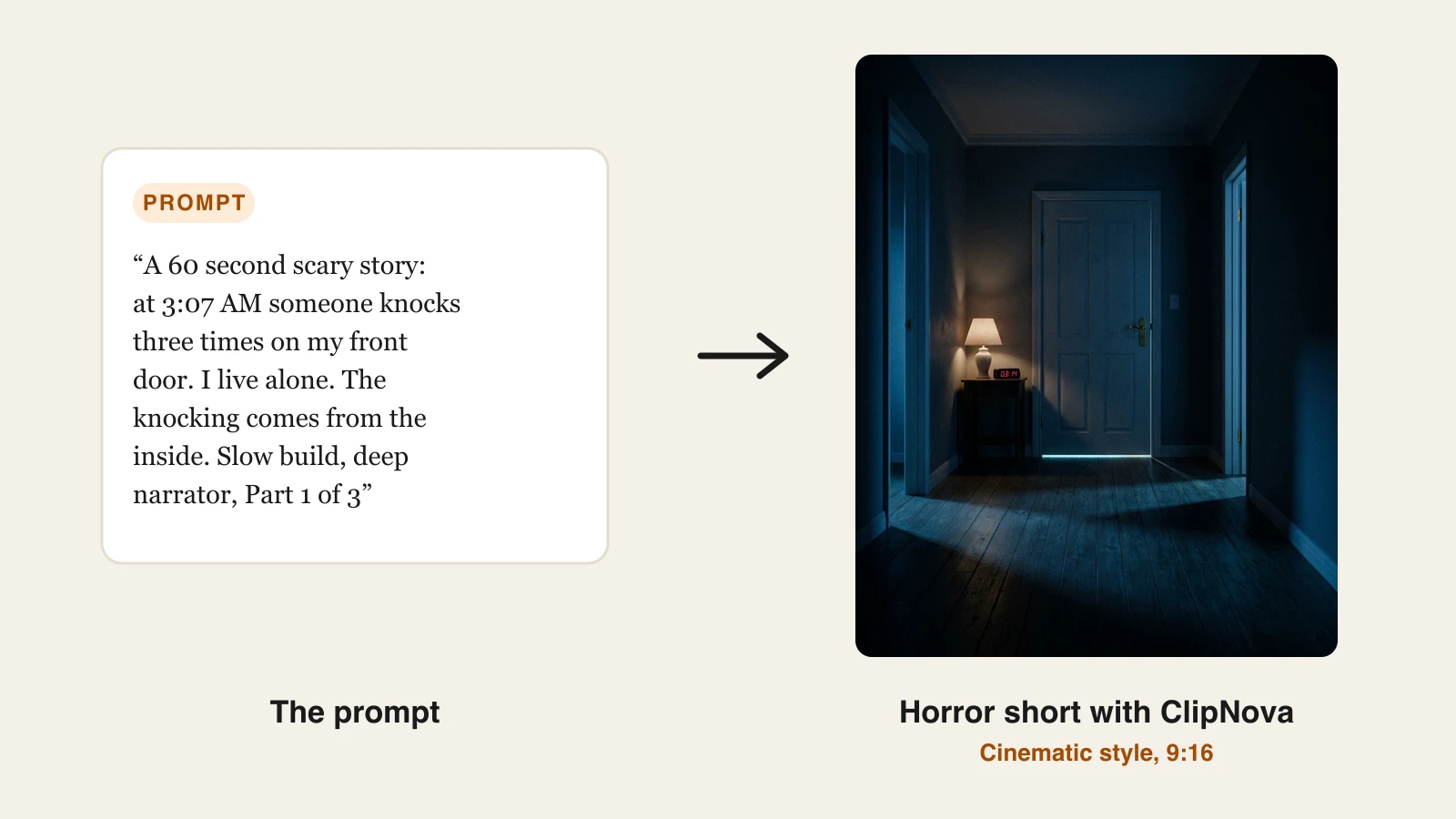
The prompt on the cover produced the opening frame, and the three beats of the story came out like this:
Plans start at $19 a month with the full feature set and full commercial rights on every tier; the pricing page has the credit breakdown.
Sound does half the work
Horror is the one faceless niche where audio matters more than visuals.
- Narrator: slower than feels natural, low, calm. Calm is scarier than dramatic.
- Music: a low drone, not a soundtrack. It should be barely noticeable until it stops.
- Silence: cut the music for one second before the twist. Viewers feel it.
- Captions: word by word, centered, so the twist lands visually at the same moment it is spoken.
Turn it into a series
Single stories get views. Series get subscribers.
- End Part 1 on the most unresolved moment and title it "Part 1". People follow to get Part 2.
- Keep the same narrator voice, the same visual style, and the same opening line format on every episode, so a viewer recognizes your channel in one second.
- Post Part 2 within a day or two, while the comments are still asking.
Prompts you can copy
- The knock: "A 60 second scary story: at 3:07 AM someone knocks three times on my front door. I live alone. The knocking comes from the inside. Slow build, deep narrator, Part 1 of 3."
- The rule list: "A 70 second horror story about a night-shift job with a list of strange rules. Rule 4 says never answer the phone after 2 AM. Tonight it rings."
- The photo: "A 60 second scary story: I found an old photo of my house from 1962. There is someone standing in my bedroom window. The photo was taken yesterday."
- The urban legend: "A 75 second retelling of a classic hitchhiker urban legend, told as if it happened to the narrator's uncle, rainy highway at night, ends on a single line twist."
What goes wrong, and the fix
- The twist is in the title. Title the setup, never the ending.
- Gore instead of dread. Graphic images get limited and are rarely scary. Dark rooms, open doors, and silhouettes do more.
- Too bright. Ask for low-key lighting, cold moonlight, and heavy shadows.
- Rushed narration. Pick a slower voice or cut words. Pauses are the scary part.
- Presented as true. If you invented it, do not call it a true story. YouTube requires disclosure for realistic AI scenes of events that never happened.
Write three stories before you make the first video, then post them as a small batch. The first week tells you which hook style your audience stays for, and that is the one to turn into a series.
Frequently asked
How do I make an AI horror story video?
Write a 120 to 160 word story with a hook in the first line, a slow build, and a twist in the last line. Generate it as a 9:16 video with dark cinematic visuals, a slow deep narrator, low ambient music, and word-synced captions. In ClipNova that is AI Video Studio, then AI Storytelling with the scary stories niche, or Prompt to Video with the Cinematic or Film Noir style.
How long should a horror story Short be?
45 to 75 seconds. That is enough for a hook, three or four beats, and a twist, and short enough that most viewers reach the ending. Longer stories work better as a Part 1, Part 2 series.
What makes a good horror story hook?
A specific time, a specific place, and something that should not be possible, all in the first sentence. "At 3:07 AM someone knocked on my door. I live alone." works because it raises a question the viewer needs answered.
Can I monetize AI horror story videos?
Yes, if the stories are original and made with care. YouTube excludes mass-produced and repetitive content from monetization, so avoid reading copied Reddit posts word for word or posting near-identical videos. Your own scripts, a consistent narrator, and a clear series format hold up.
Do I have to label AI horror videos as AI on YouTube?
YouTube requires disclosure when AI creates a realistic scene that did not happen, which covers photorealistic horror presented as real. Clearly fictional stories are fine, and the label does not limit reach or monetization. Never present an invented story as a true crime or a real event.