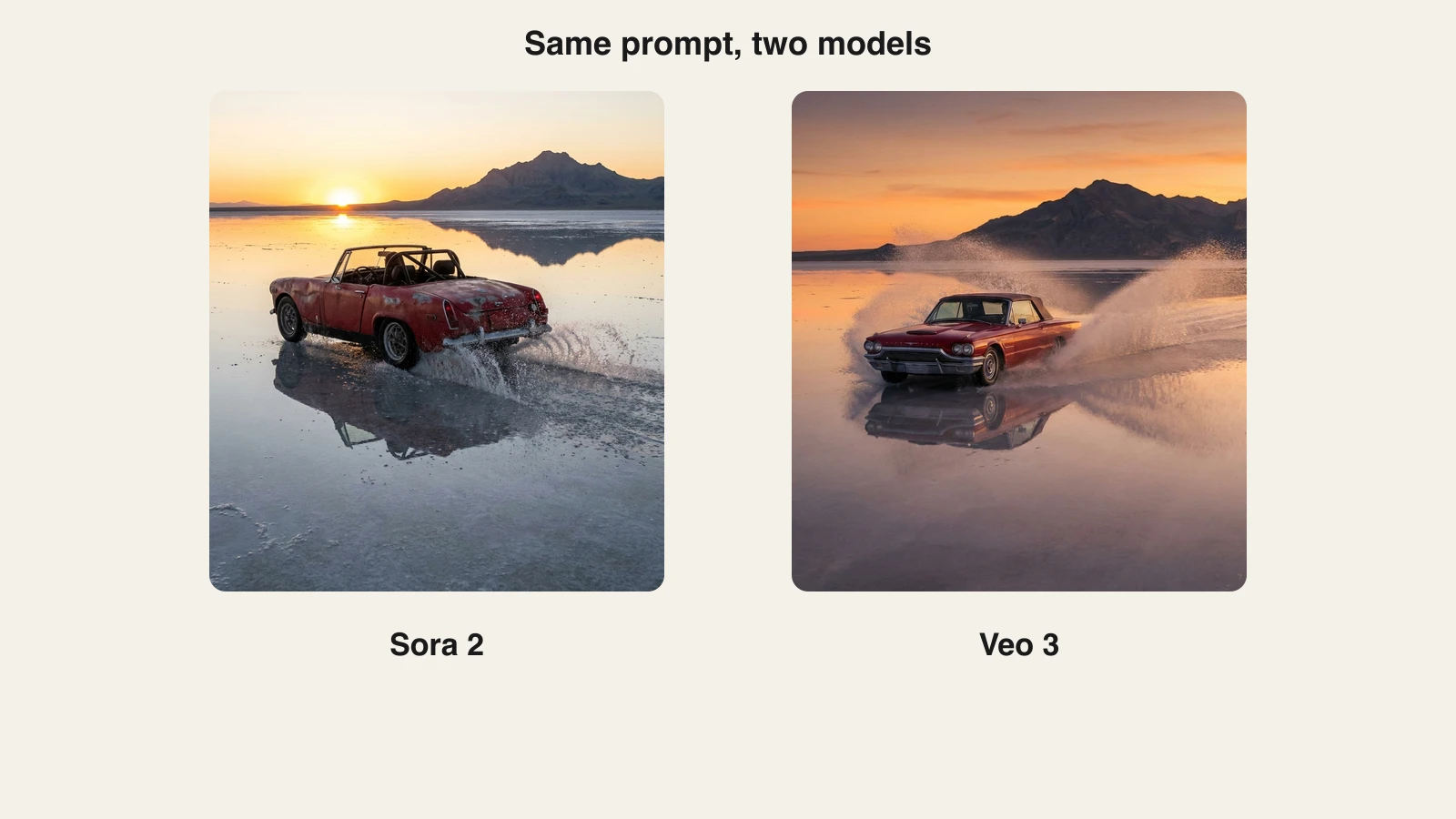
Sora 2 and Veo 3.1 are the two most famous AI video models of this generation, and in 2026 the answer to which one wins depends on access as much as output. Sora 2, OpenAI's September 2025 release, still produces some of the most physically believable clips ever generated, up to 25 seconds long with lip-synced dialogue. Veo 3.1, Google's current release in the Veo 3 family, answers with 4K output, native vertical framing, and monthly updates. The twist: OpenAI shut down the Sora app and sora.com on April 26, 2026, so the practical way to generate with Sora 2 today is through a platform that hosts the model. ClipNova hosts Sora 2 and Veo 3.1 side by side on one subscription from $39 a month.
This comparison covers where each model genuinely leads, what access actually costs in 2026, and a side-by-side render of the same prompt in both styles, so you can decide with evidence instead of brand loyalty.
Sora vs Veo: the quick verdict
Choose Sora 2 when the shot lives or dies on believable physics or needs to run long: a continuous take up to 25 seconds, characters speaking with synchronized dialogue, action where weight and momentum have to look real.
Choose Veo 3.1 when you need resolution, format flexibility, and a dependable pipeline: 4K masters, vertical 9:16 for Shorts and Reels, shots you can extend past a minute in Flow, and a model that is still actively developed.
| What matters | Sora 2 | Veo 3.1 |
|---|---|---|
| Made by | OpenAI | Google DeepMind |
| Released | September 2025 | October 2025, 4K and vertical added January 2026 |
| Max resolution | 1080p (Pro) | Up to 4K |
| Clip length | 10 to 25s in a single take | 8s per generation, extendable to 1 min+ in Flow |
| Native audio | Yes, lip-synced dialogue and effects | Yes, dialogue, ambient sound, and effects |
| Strongest at | Physics realism, long single takes | Resolution, vertical output, ecosystem |
| Direct access today | None: app and sora.com closed April 2026 | Gemini app and Flow, from $19.99/mo |
| Inside ClipNova | Yes (Sora 2) | Yes (Veo 3.1, plus Fast and Lite variants) |
One framing note before the deep dive: this is no longer a race between two companies shipping at the same pace. Google iterates on Veo every few months, while Sora 2 is a frozen snapshot of where OpenAI's video research stood before the company pulled back. That asymmetry shapes most of what follows.
Where Sora 2 wins
Physics and world simulation. OpenAI built Sora 2 explicitly as a step toward simulating the physical world, and it shows in the details that betray most AI video: a missed basketball shot rebounds off the backboard instead of warping into the hoop, water carries real momentum, objects keep their weight through collisions. When the subject is sport, liquids, or fast physical action, Sora 2's best takes still look more true than almost anything else, Veo 3.1 included.
Long single takes. Sora 2 generates 10 or 15 second clips, and Sora 2 Pro reaches 25 seconds in one continuous pass. Veo 3.1 caps a single generation at 8 seconds and relies on Extend to go longer, which stitches new generations onto the last one. The same idea works on any clip with an AI video extender, which continues the scene from the final frame. For an unbroken shot where a character walks, talks, and reacts without a hidden cut, Sora 2 holds the clearest spec advantage in this matchup.
Dialogue-driven scenes. Both models generate synchronized audio, but Sora 2 was designed around characters that speak. It lip-syncs dialogue convincingly across multi-shot scenes and keeps voices consistent within a clip, which made it the go-to for talking micro-skits during the app's brief life.
The trade-offs. Resolution tops out at 1080p with no 4K path, and the bigger issue is structural: OpenAI discontinued the Sora app and sora.com on April 26, 2026, roughly six months after launch, and has scheduled the Sora 2 API shutdown for September 24, 2026. There is no first-party consumer door left, no roadmap, and no Sora 3 announced. If you want this style of output with an actual future attached, the Sora alternative page breaks down the current options.
Where Veo 3 wins
Resolution and formats. Veo 3.1 outputs 720p, 1080p, and since the January 2026 update native 4K, with vertical 9:16 generation for TikTok, Reels, and Shorts. Sora 2 never shipped 4K. If your deliverable is a crisp master you can crop and downscale per platform, Veo 3.1 is the only one of the two that produces it.
An ecosystem that keeps shipping. Around the model, Google built Flow: Ingredients to Video combines reference images into a scene, Frames to Video animates between a start and end frame, and Extend chains 8 second generations into shots of a minute or more. The 3.1 release brought richer native audio to all of those features, and the Fast and Lite variants cut the cost of iteration drafts. Nothing on the Sora side has received an update since early 2026.
Access on your terms. You can subscribe to Google AI Pro at $19.99 a month for regular generation with 1,000 monthly AI credits, scale to the Ultra tiers at $99.99 or $199.99 for heavy Flow use, or pay per second through the API from roughly $0.10 per second for Veo 3.1 Fast. Sora 2's remaining first-party path, the API, prices at about $0.10 per second for the standard model and from $0.30 per second for Pro, and it disappears in late September 2026.
A future. This is the quiet decider. Google retired the original Veo 3 from Vertex AI in June 2026 precisely because 3.1 superseded it, and the cadence points to further releases. Building a content pipeline on Veo means the model under it keeps improving. Building one on Sora 2 means betting on a model whose owner has moved on, which is why so many former Sora users have migrated; the Veo 3 alternative page covers where they landed.
The trade-offs. Eight seconds per generation is the format's real constraint, and extended shots can drift in consistency across hops. On physics-heavy prompts, Sora 2's best takes still edge out Veo's. And 4K generation with audio gets expensive fast at API rates that reach $0.60 per second.
Same prompt, two models
The fastest way to feel the difference is to render one prompt through both. We used this prompt:
A barista pours latte art into a white ceramic cup in slow motion, steam curling through warm morning light in a quiet cafe, camera slowly pushing in.
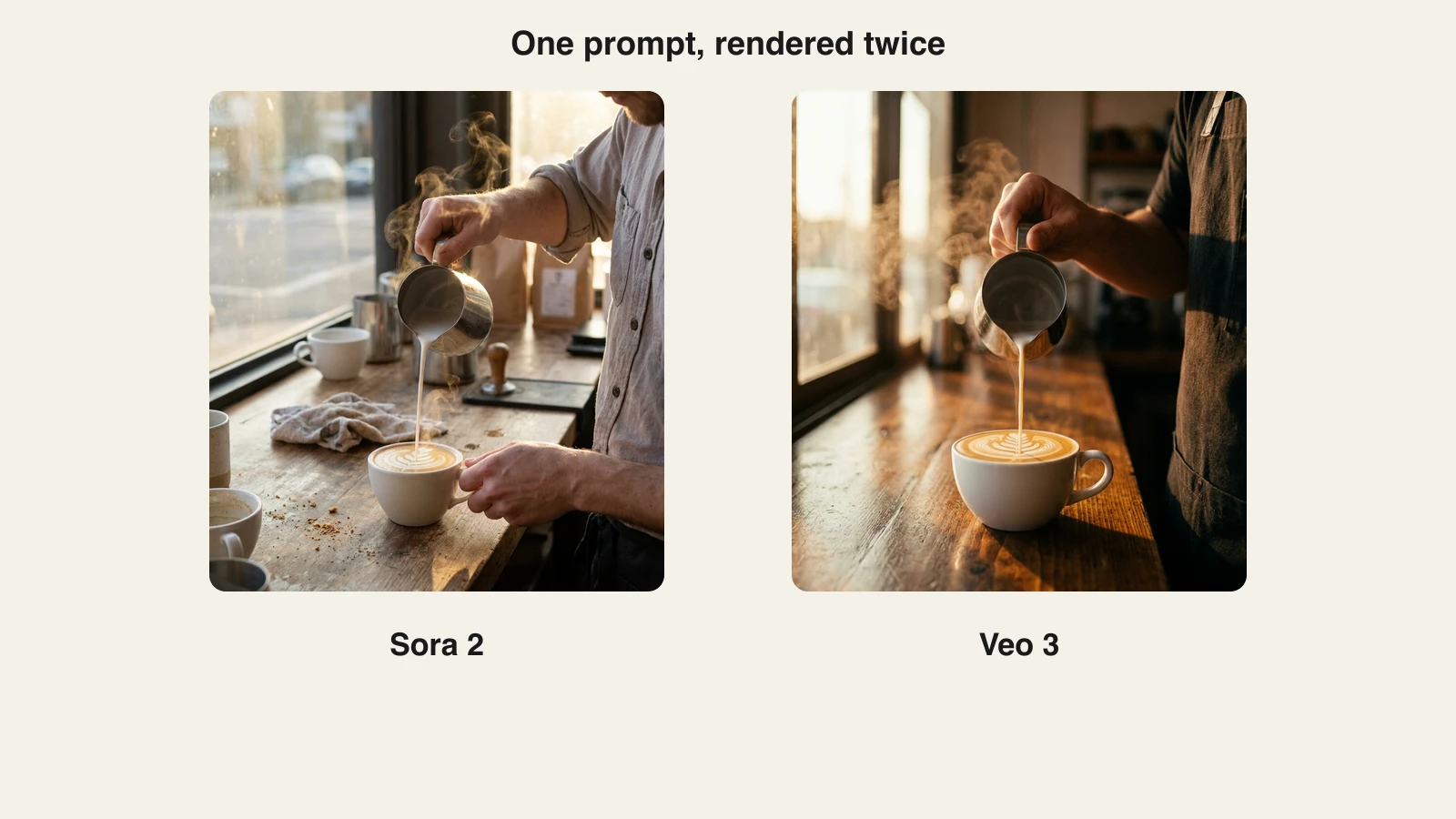
The pattern repeats across most prompts. The Sora-side frame reads like found footage: natural light, honest textures, milk that pours the way milk pours. The Veo-side frame reads like the same moment shot for a commercial: composed framing, richer grade, every surface flattering. Neither is wrong. One prioritizes what is true, the other what is beautiful, and the right pick depends on whether the brief says authentic or polished.
How to run Sora 2 and Veo 3.1 inside ClipNova
Since the Sora app closed, running this comparison yourself through official channels means an API key with a shutdown date on one side and a Google subscription on the other. ClipNova removes that friction: it hosts Sora 2 and Veo 3.1 (plus Veo 3.1 Fast and Lite, Kling 3.0, Seedance, Flux-3, and Pixverse) in one models hub, on a single plan from $39 a month. Here is the exact workflow:
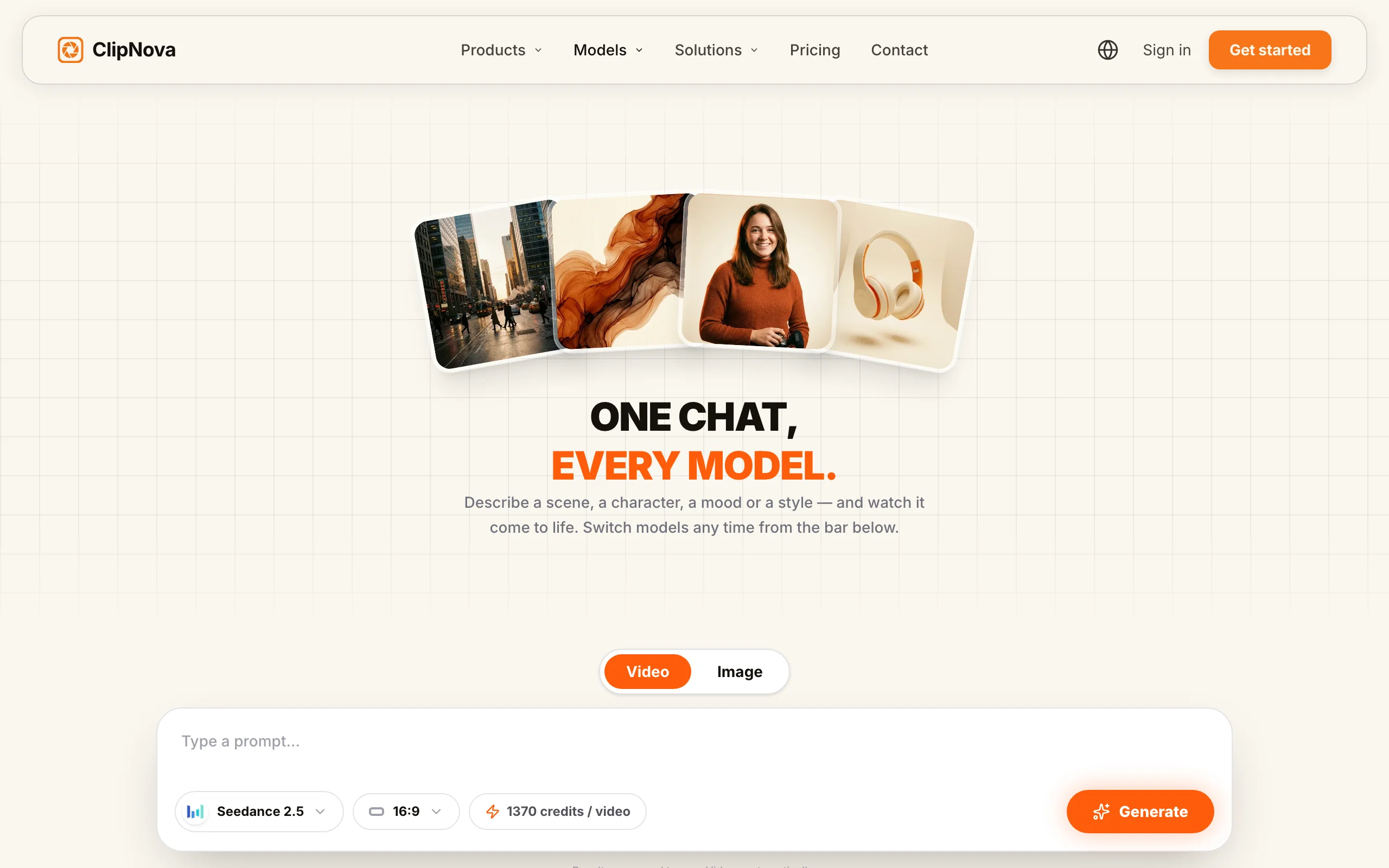
- Go to app.clipnova.io.
- Open the models chat and pick Sora 2 from the model bar.
- Paste your prompt. Ours was: "A barista pours latte art into a white ceramic cup in slow motion, steam curling through warm morning light in a quiet cafe, camera slowly pushing in."
- Generate. Sora 2 rewards physical specifics, so describe materials, motion, and light rather than adjectives.
- Switch the model bar to Veo 3.1 and run the identical prompt in the same thread. Add "vertical 9:16" if the clip is headed for Shorts or Reels.
- Download the better take watermark-free and publish. Every export carries full commercial rights on every plan.
Because both renders live in one thread, an A/B test that would otherwise need two accounts takes about five minutes. The $39 a month Hobby plan includes 1,000 credits and the full feature set, which covers plenty of head-to-head experiments on one subscription.
How to choose between Sora and Veo
1) Does the shot need to run past eight seconds in one take?
- If yes, an unbroken 15 to 25 second take with dialogue: Sora 2. No extension trick matches a genuine single pass.
- If cuts are fine or the clip is short anyway: Veo 3.1, and use Extend when a scene needs to breathe.
2) Where will the video be published?
- If you need 4K masters or native vertical for TikTok, Reels, and Shorts: Veo 3.1. Sora 2 stops at 1080p.
- If it is a 1080p social clip where realism sells the moment: Sora 2 remains competitive frame for frame.
3) How much does physics matter?
- If viewers would notice fake movement, sports, water, crowds, collisions: Sora 2's world simulation is still the benchmark.
- If the shot is about look and composition more than motion truth: Veo 3.1's cinematic polish wins more briefs.
4) Are you buying a model or a future?
- If you are building a repeatable pipeline, Veo 3.1 is the safer foundation: active development, stable first-party access, a growing toolset. Compare the wider field in our guide to the best text to video AI tools.
- If you want both answers without betting on either, run them side by side inside ClipNova and keep the winner per brief. Plans run from $39 a month; current plans are on the ClipNova pricing page.
Test three or four prompts from your actual content calendar through both models before committing to a workflow. With Sora 2's official doors closing, this is also simply the easiest moment to find out what you would be giving up.
Related reading: Veo 3 vs Kling: which AI video model wins? (2026).
Frequently asked
Is Sora 2 better than Veo 3?
Neither wins outright in 2026. Sora 2 leads on physics realism, lip-synced dialogue, and single-take length up to 25 seconds. Veo 3.1 leads on resolution with 4K output, native vertical framing, extendable shots in Flow, and the fact that Google still ships updates while OpenAI has frozen Sora development. For most publishing workflows Veo 3.1 is the safer default, and Sora 2 is the specialist for physics-heavy or longer single shots.
What happened to the Sora app?
OpenAI announced on March 24, 2026 that it was shutting down the Sora social app, and the app and sora.com were discontinued on April 26, 2026. Usage had fallen sharply after launch and the app reportedly earned far less than it cost to run. The Sora 2 model itself was not deleted, but OpenAI no longer offers a consumer product around it, and the Sora 2 API is scheduled to shut down on September 24, 2026.
Can I still use Sora 2 in 2026?
Yes, through platforms that host the model. ClipNova hosts Sora 2 in its models hub alongside Veo 3.1, Kling 3.0, Seedance, and others, on one subscription from $39 a month. Direct OpenAI access is gone for consumers, and developers only have the API until September 24, 2026, so a hosted platform is the practical route now.
How long can Sora 2 videos be?
Sora 2 generates clips of 10 or 15 seconds, and Sora 2 Pro reaches 25 seconds in a single pass at up to 1080p with synchronized audio. That single-take length is still one of the longest of any frontier video model and remains Sora 2's clearest spec advantage over Veo 3.1's 8 second generations.
How long can Veo 3.1 videos be?
A single Veo 3.1 generation is 8 seconds. The Extend feature in Google Flow chains continuations of the same shot into clips of a minute or more, and API-side extension supports roughly two and a half minutes, but each hop is a new generation stitched to the last rather than one continuous take.
How much does Veo 3 cost in 2026?
The consumer route is a Google AI subscription. Google AI Pro at $19.99 a month includes Veo 3.1 video generation in the Gemini app and Flow with 1,000 monthly AI credits, and the Ultra tiers at $99.99 and $199.99 raise those limits for heavy use. API pricing starts around $0.10 per second for Veo 3.1 Fast. ClipNova also hosts Veo 3.1 within its $39 a month Hobby plan.
Does Veo 3 generate audio?
Yes. Veo 3.1 generates native synchronized audio in the same pass as the video, including dialogue, ambient sound, and effects, and the 3.1 release specifically improved audio richness across Flow features like Ingredients to Video and Extend. Sora 2 also generates synchronized audio, so neither model outputs silent footage.
Which is better for YouTube Shorts and Reels, Sora or Veo?
Veo 3.1 is the stronger short-form pick in 2026. It renders native vertical 9:16 video, outputs up to 4K for clean downscaling, and its 8 second generations match short-form pacing. Sora 2 supports vertical framing too, but with no first-party app its workflow depends on the platform hosting it. Inside ClipNova you can run the same vertical prompt through both models and keep the better take.