AI ASMR videos took off in June 2025, when Google's Veo 3 started generating sound together with the picture. A knife sliced through a strawberry made of glass, the crunch was perfectly in sync, and one TikTok account went from nothing to 147,000 followers in five days. The format has not slowed down since: impossible objects, satisfying cuts, and crisp sound.
It is also one of the few faceless formats that needs no script and no voice, which makes it a natural fit next to the other faceless YouTube Shorts niches. This guide shows how to make ASMR videos with AI, from picking the trigger to writing the prompt, with the exact steps in ClipNova.
Sound first: why most AI ASMR fails
ASMR is a sound format that happens to have pictures. Most AI video models generate silent clips, so people add a stock sound effect afterwards, and it never lines up with the knife. The viewer notices in half a second.
What you need is a model that generates synced audio: the crunch happens on the exact frame the blade goes in. That is the whole trick, and it is why the trend only started once native-audio video models arrived.
Pick one trigger
Every good ASMR clip is built on a single trigger. Pick one per video:
- Cutting: glass fruit, crystal, kinetic sand, soap, ice, a cake that looks like a household object.
- Crunching and crackling: biting into something brittle, breaking a sugar shell, stepping on thin ice.
- Pouring: honey, molten glass, liquid metal, thick paint.
- Tapping and scratching: fingernails on glass, wood, or ceramic.
- Squishing: slime, stress balls, jelly.
The most-watched AI ASMR clips combine a real sound with an impossible object. Glass fruit works because everyone knows what cutting fruit sounds like, but nobody has seen a glass kiwi split open.
Write an ASMR prompt
A good ASMR prompt has five parts. Write them in this order:
- The shot: extreme macro close-up, static camera, shallow depth of field.
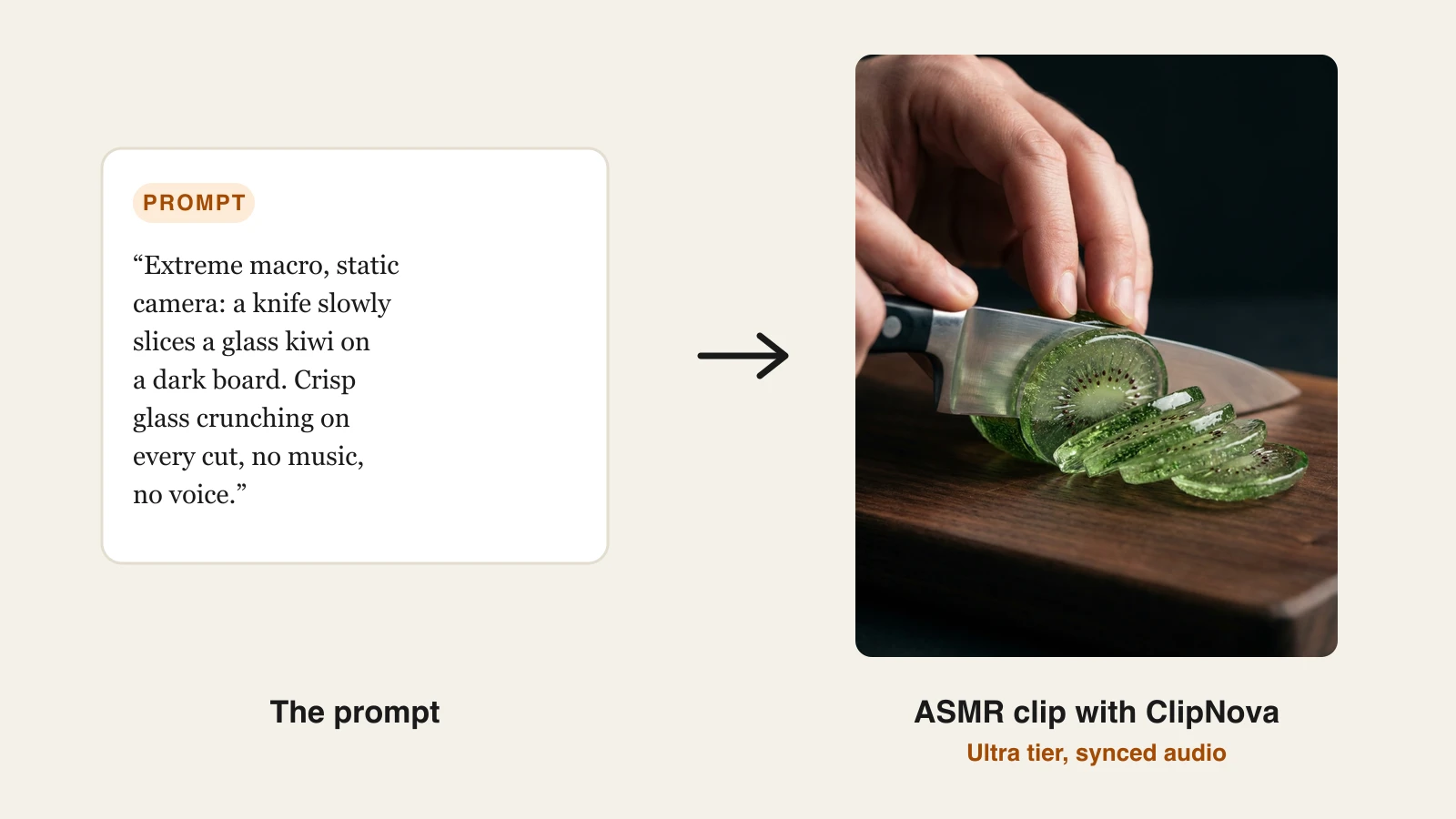
- The object: a translucent glass kiwi with visible seeds inside, on a dark wooden board.
- The action: a sharp knife slowly slices it into thin, even slices.
- The light: soft studio light from the side, glossy reflections, dark background.
- The sound: crisp glass crunching on every cut, quiet room, no music, no voice.
Put together: "Extreme macro close-up, static camera: a sharp knife slowly slices a translucent glass kiwi with visible seeds into thin slices on a dark wooden board. Soft side light, glossy reflections, dark background. Crisp glass crunching on every cut, quiet room, no music, no voice."
Always write no music and no voice. Background music ruins ASMR, and models add it unless told not to.
Make it with ClipNova
ClipNova generates ASMR clips with synced sound from a prompt. The Video chat on the app's home screen makes the sound together with the picture, so the crunch lands on the cut, and you do not need to choose a model. The AI text to video generator page shows the same tool.
ASMR is one short clip at a time. For everything longer, ClipNova makes finished long videos with consistent characters: up to 5 minutes, the same saved face in every scene, with narration, captions and music done.
- Sign in at app.clipnova.io and pick a plan. Synced-audio clips run in the Video chat (plans from $39 a month; the pricing page has the credit breakdown).
- Open the Video chat on the app's home screen.
- Paste your five-part prompt and end it with "no music, no voice".
- Pick 9:16 for TikTok, Shorts, and Reels, and keep the clip at about 8 seconds so it stays one continuous take.
- Generate, listen with headphones, and regenerate if the sound is late or the object warps.
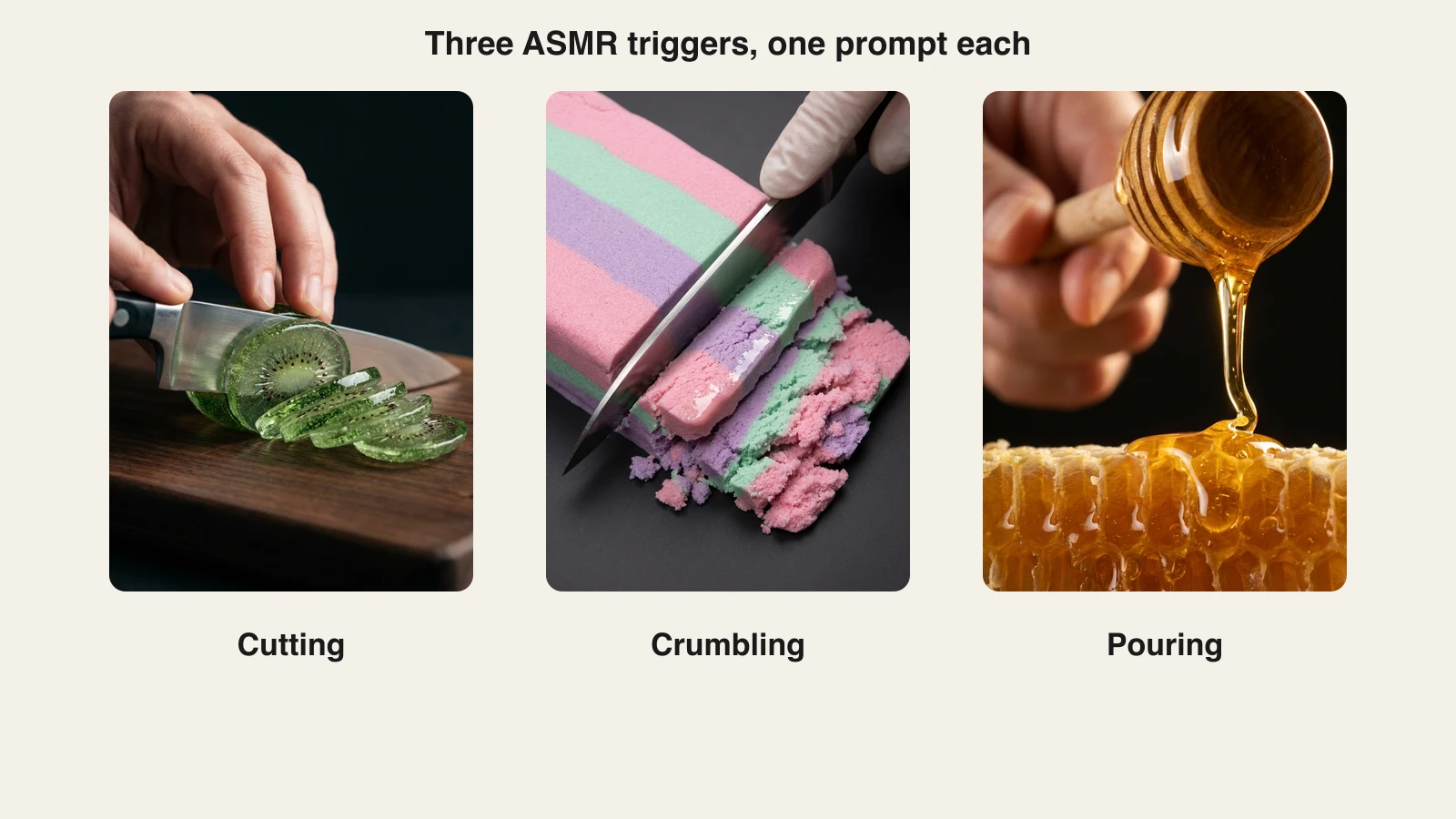
Three triggers from the same session:
For a longer video, generate four to six clips of the same object and the same light, then post them as one compilation.
Prompts you can copy
- Glass fruit: "Extreme macro close-up, static camera: a knife slowly slices a glass strawberry into thin translucent slices on a marble board. Soft light, glossy reflections. Crisp glass crunching on every cut, no music, no voice."
- Kinetic sand: "Top-down macro shot: a metal blade slowly cuts through a block of layered pastel kinetic sand, the slices crumble softly. Even studio light. Soft sand crumbling sounds, no music."
- Honey pour: "Macro close-up: thick golden honey pours slowly over a honeycomb, dripping into the cells. Warm backlight. Sticky dripping and soft crackling of wax, quiet room, no music."
- Ice: "Macro close-up: a small hammer taps a thin sheet of blue ice until it cracks into shards. Cold light, dark background. Sharp cracking and tinkling ice, no music, no voice."
What goes wrong, and the fix
- The sound is late or generic. Name the sound and when it happens: "crunching on every cut", "a crack on each tap".
- The object melts or changes shape. Use a static camera, one object, and one slow action.
- Music appears. Add "no music, no voice" at the end of every prompt.
- Too busy. One object, one surface, a dark or plain background. Clutter distracts from the sound.
- Every video is identical. YouTube excludes mass-produced, repetitive content from monetization. Vary the objects, build themed series, and add something of your own, such as a recurring set or a named collection.
Glass fruit made the format famous, but the channels that last pick a signature trigger and own it. Make ten clips with ten different objects, post them over two weeks, and double down on whichever sound people replay.
Frequently asked
How do I make ASMR videos with AI?
Pick one trigger (cutting, crunching, pouring, tapping), write a prompt with an extreme macro shot, one object, one slow action, soft light, and the exact sound, and end it with "no music, no voice". Generate it with a model that creates synced audio. In ClipNova that is the Video chat on the app's home screen.
Which AI makes ASMR videos with sound?
You need a video model that generates audio together with the picture, such as Google's Veo 3 family. ClipNova's Video chat on the app's home screen renders clips of up to 1080p with synced sound, so the crunch lands on the cut.
How long should an AI ASMR video be?
Each clip works best at about 8 seconds, one object and one continuous action. For a longer upload, generate several clips with the same set and light and post them as a compilation.
Why are glass fruit cutting videos so popular?
They pair a sound everyone knows, a knife cutting fruit, with an object nobody has seen, a strawberry or kiwi made of glass. The satisfying crunch plus the impossible visual keeps people watching and replaying. The trend took off on TikTok in June 2025 after Veo 3 added native sound.
Can I monetize AI ASMR videos?
Yes, if each video is made with care and is not mass-produced. YouTube excludes repetitive, near-identical content from monetization, so vary your objects, build themed series, and keep a recognizable style of your own.