There has never been more choice in AI models, and never less agreement on which one is "best." In 2026 the leading models from Google, OpenAI, Anthropic, xAI, and Perplexity are close enough on quality that the real differences show up in cost and speed, not headline accuracy.
So instead of arguing from vibes, this comparison uses numbers. We ran eight leading models through the same hands-on benchmark and measured three things that actually decide which model you should ship: how accurate it is, how fast it responds, and how much it costs at scale.
The short version: the most accurate model is not the one most teams should use. Here is the data, chart by chart.
Best AI models in 2026: a brief overview
- Gemini 3.1 Pro: Best raw accuracy. Tops the benchmark at 80%, but it is the slowest and most expensive to run.
- Gemini 3.1 Flash-lite: Best value overall. 75% accuracy at roughly 25x lower cost than the top model, and the fastest of the group.
- GPT-5.4: Best balance of quality and speed. 75% accuracy with quick responses and mid-tier cost.
- Claude Opus 4.6: Best for hard reasoning where budget is secondary. 75% accuracy, premium cost tier.
- Gemini 3 Flash: Solid mid-tier all-rounder. 65% accuracy at low cost.
- Sonar (Perplexity): Best for answers grounded in live search. 65% accuracy, higher cost.
- Grok 4 Fast: Cheapest option. 55% accuracy at about $3.75 per 10,000 calls.
- GPT-5 Nano: Best ultra-cheap OpenAI option. 55% accuracy for high-volume, low-stakes work.
| Model | Provider | Accuracy | Avg. speed | Cost / call | Cost / 10K calls |
|---|---|---|---|---|---|
| Gemini 3.1 Pro | 80% | 23.48s | $0.0292 | ≈$292 | |
| Gemini 3.1 Flash-lite | 75% | 6.24s | $0.00114 | ≈$11 | |
| GPT-5.4 | OpenAI | 75% | 8.45s | $0.0128 | ≈$128 |
| Claude Opus 4.6 | Anthropic | 75% | 12.44s | $0.0246 | ≈$246 |
| Gemini 3 Flash | 65% | 16.36s | $0.00735 | ≈$74 | |
| Sonar | Perplexity | 65% | 10.61s | $0.0256 | ≈$256 |
| Grok 4 Fast | xAI | 55% | 7.31s | $0.000375 | ≈$4 |
| GPT-5 Nano | OpenAI | 55% | 12.35s | $0.000592 | ≈$6 |
Which model is most accurate?
On accuracy alone, Gemini 3.1 Pro leads at 80%, a clear 5-point margin over the pack. Below it, three very different models, Gemini 3.1 Flash-lite, GPT-5.4, and Claude Opus 4.6, tie at 75%. Then a step down to 65% (Gemini 3 Flash and Sonar) and a budget tier at 55% (Grok 4 Fast and GPT-5 Nano).
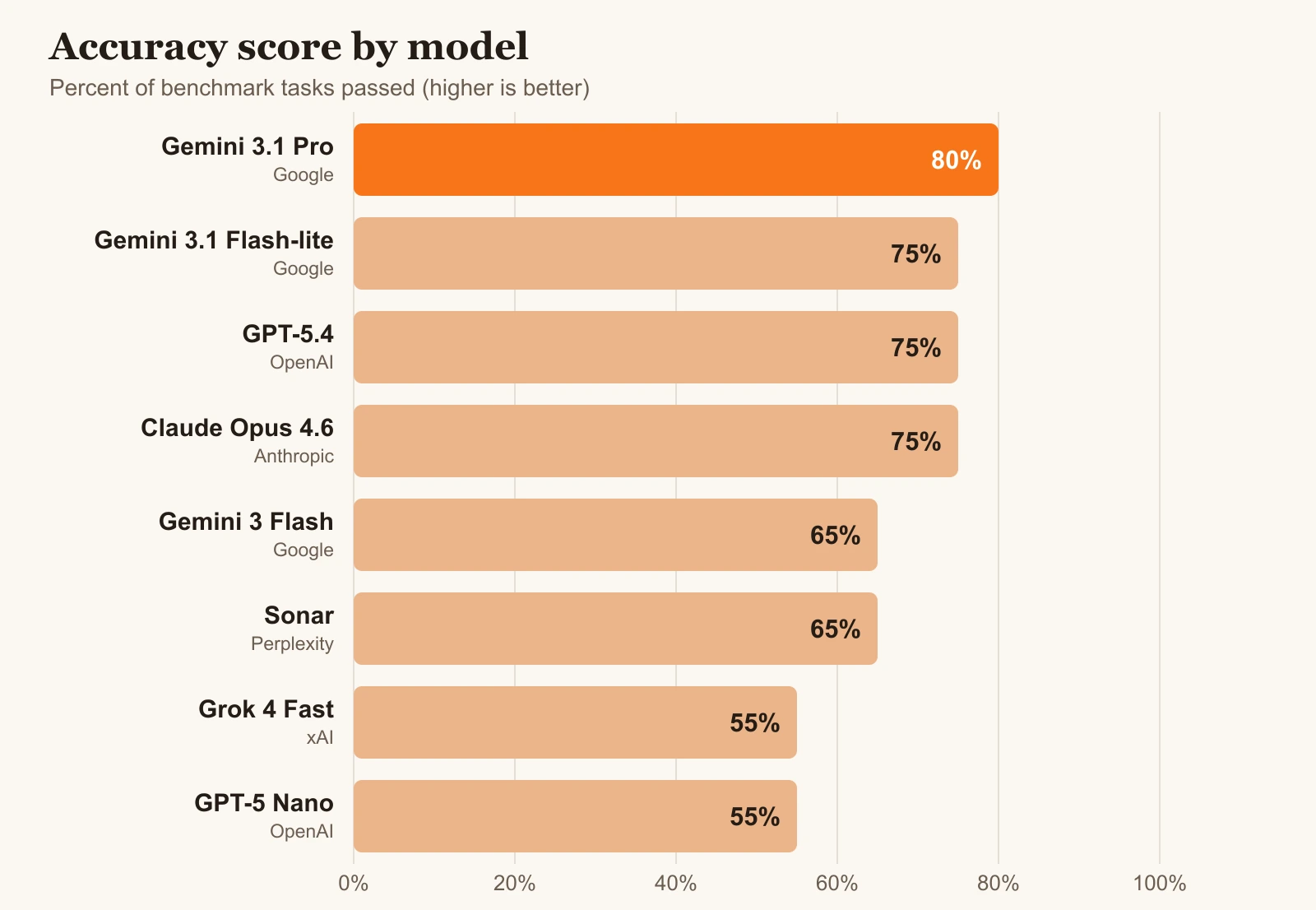
The takeaway is how flat the top is. Four models sit within 5 points of each other, so if your tasks are not at the absolute frontier of difficulty, the accuracy race is nearly a tie, and the decision moves to cost and speed.
What each model costs at scale
This is where the models stop looking similar. Priced out across 10,000 calls, the same benchmark job ranges from about $3.75 on Grok 4 Fast to about $292 on Gemini 3.1 Pro, an almost 80x spread.
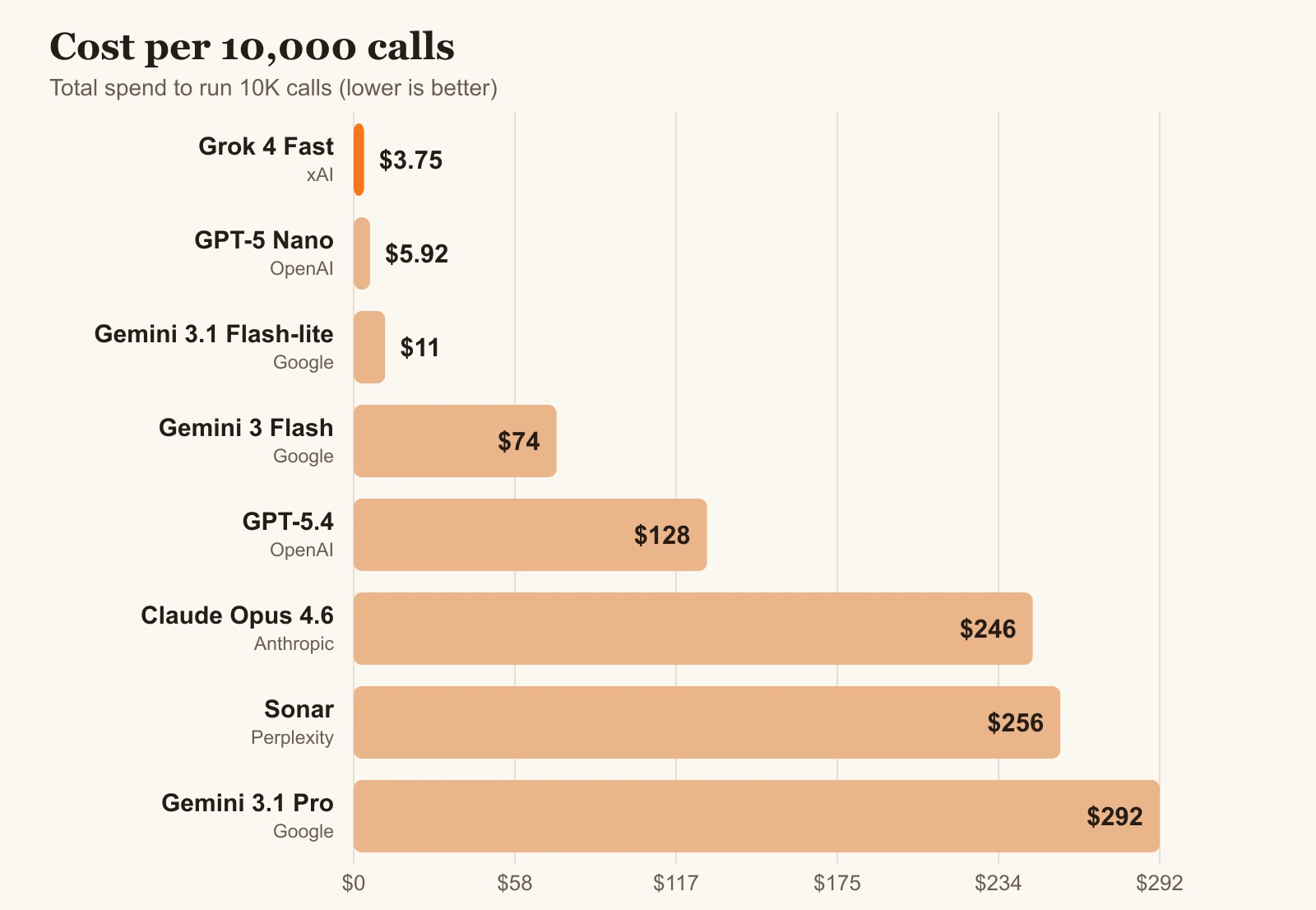
The number that jumps out is Gemini 3.1 Flash-lite at roughly $11 for the same 10,000 calls the Pro model charges $292 for. That is a 96% cost saving for a 5-point accuracy drop. At low volume the difference is lunch money; at production volume it is the difference between a viable feature and a budget line nobody approves.
The value frontier: accuracy per dollar
Plotting accuracy against cost per call makes the real story obvious. The best position is high and to the left: strong accuracy, low cost.
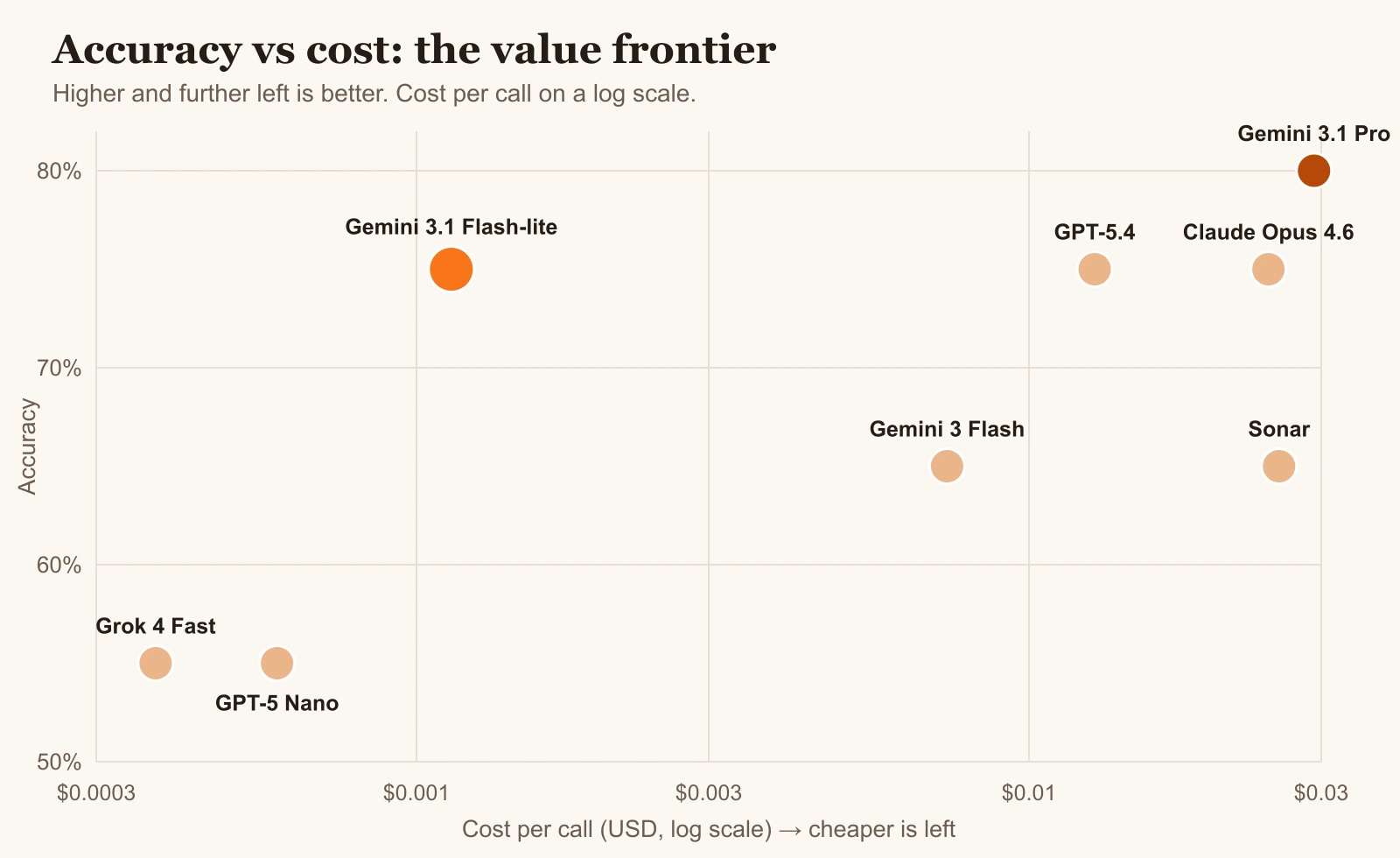
Gemini 3.1 Flash-lite sits alone in the sweet spot: near-top accuracy at a cost closer to the budget models than to the premium tier. Gemini 3.1 Pro anchors the top-right, paying a steep premium for its extra 5 points. Claude Opus 4.6 and Sonar are expensive for their 75% and 65% scores, while Grok 4 Fast and GPT-5 Nano trade accuracy for rock-bottom pricing. If you draw the line of "most accuracy per dollar," Flash-lite defines it.
Speed: how long you wait per call
Latency matters for anything user-facing, and here the ranking flips again. Gemini 3.1 Flash-lite is fastest at about 6.24 seconds, with Grok 4 Fast and GPT-5.4 close behind. The most accurate model, Gemini 3.1 Pro, is the slowest at 23.48 seconds, nearly 4x slower than Flash-lite.
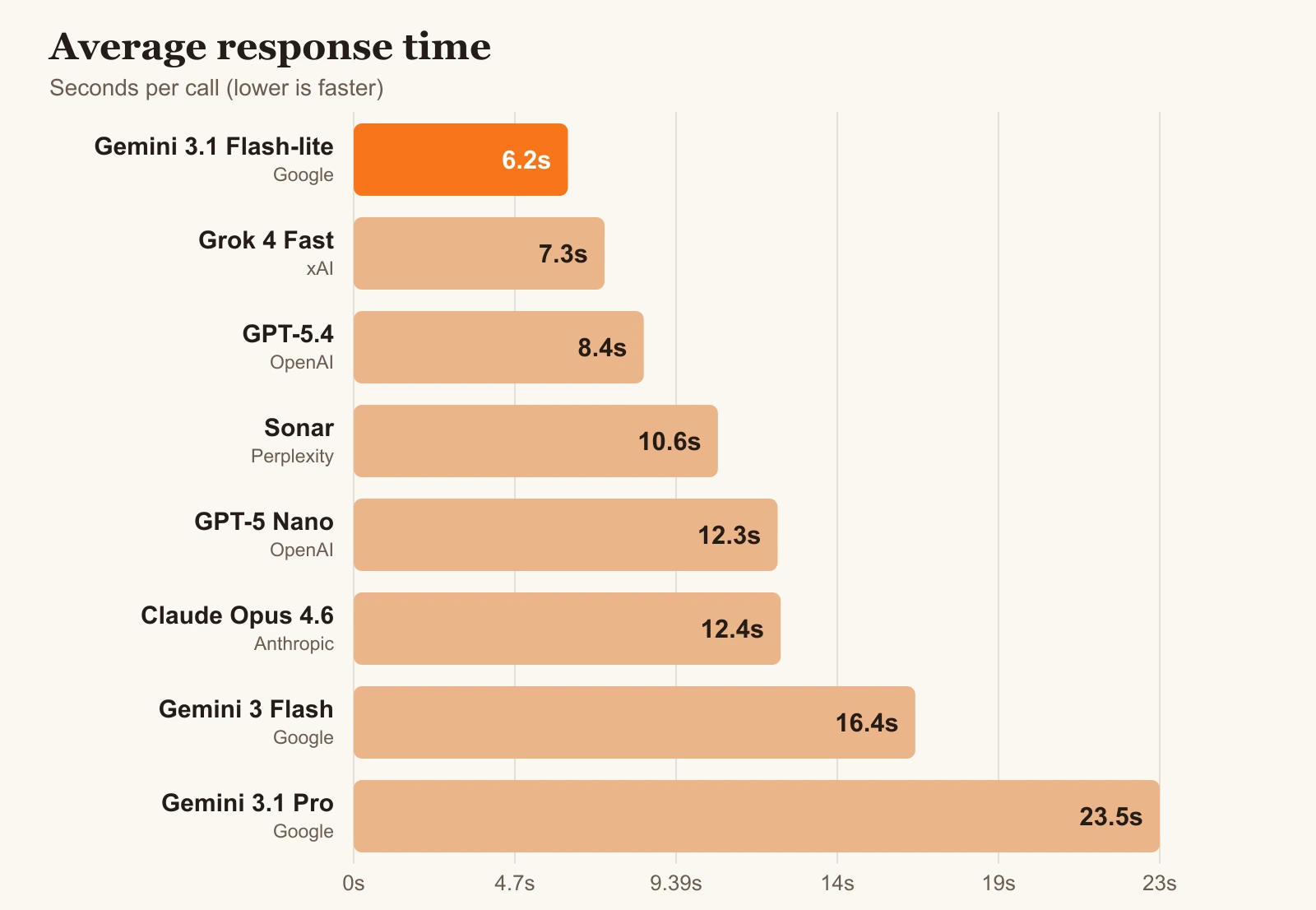
For a background job that runs overnight, 23 seconds is fine. For a chat interface or a live tool, it is an eternity, and Flash-lite's speed becomes as important as its price.
Model-by-model verdict
- Gemini 3.1 Pro (Google): The accuracy champion. Reach for it only when a task genuinely needs the extra 5 points and you can absorb the cost and the latency.
- Gemini 3.1 Flash-lite (Google): The value winner and the sensible default. 75% accuracy, the fastest response, and about 25x cheaper than Pro.
- GPT-5.4 (OpenAI): The balanced pick. Matches Flash-lite and Opus on accuracy, is quick, and sits mid-cost, a safe general choice.
- Claude Opus 4.6 (Anthropic): Strong 75% accuracy, but the most expensive tier. Best when reasoning quality outweighs budget.
- Gemini 3 Flash (Google): A capable 65% all-rounder at low cost, good for medium-stakes work.
- Sonar (Perplexity): 65% accuracy with live-search grounding, best when answers must reflect current information rather than raw model knowledge.
- Grok 4 Fast (xAI): The cheapest at about $3.75 per 10K calls. Use it for high-volume, low-stakes tasks like tagging or routing.
- GPT-5 Nano (OpenAI): OpenAI's ultra-cheap option at 55%, for scale over sophistication.
How to choose the right AI model
1) Optimize for accuracy
If a wrong answer is expensive and volume is low, pay for the top of the chart: Gemini 3.1 Pro, or GPT-5.4 and Claude Opus 4.6 when speed or ecosystem fit matter.
2) Optimize for value at scale
For most production workloads, Gemini 3.1 Flash-lite is the default: nearly the accuracy of the leaders at a fraction of the cost and latency. GPT-5.4 is the balanced alternative.
3) Optimize for cost
For high-volume, low-stakes jobs, Grok 4 Fast and GPT-5 Nano cut spend to a few dollars per 10,000 calls. Just accept the 55% accuracy and keep them off your hardest tasks.
4) Always test on your own tasks
This is one benchmark on one task set, and rankings move with the prompt, the domain, and each provider's near-constant updates. Shortlist two or three models here, then run your real inputs through them before you commit.
The same race is happening in video and images
These models are built for text and reasoning, but the pattern, several strong frontier models where no single one wins every job, is even more true in generative media. The best model for a cinematic shot is rarely the best for a fast social clip or a product image.
That is exactly why a multi-model approach wins there too. ClipNova brings the leading video and image models together in one studio, Sora, Veo, Kling, Flux, Nano Banana and more, so you can match the model to the shot instead of betting your whole workflow on one. If your next step after comparing text models is turning ideas into video, our guide to the best AI text-to-video tools picks up there.
Run the top AI models in one studio
ClipNova brings the leading AI video and image models, Sora, Veo, Kling, Flux and more, into a single workspace. Log in and generate your first result in minutes. button: Try these models on ClipNova
Frequently asked
What is the best AI model in 2026?
On the benchmark used here, Gemini 3.1 Pro scored highest at 80% accuracy, ahead of GPT-5.4, Claude Opus 4.6, and Gemini 3.1 Flash-lite, which tied at 75%. But "best" depends on what you optimize for. Gemini 3.1 Flash-lite reaches nearly the same accuracy at a fraction of the cost and much faster, which makes it the better default for most real workloads.
Which AI model gives the best value for money?
Gemini 3.1 Flash-lite. It hits 75% accuracy, just 5 points behind the top model, while costing about 25 times less per call and running roughly 3.8 times faster. For high-volume use where you make thousands of calls, that gap dominates the decision far more than a few accuracy points.
What is the cheapest AI model?
Grok 4 Fast (non-reasoning) is the cheapest in this comparison at about $3.75 per 10,000 calls, followed by GPT-5 Nano at about $5.92. Both trade accuracy for price, scoring 55%, so they suit high-volume, low-stakes tasks like classification or routing rather than hard reasoning.
Is Gemini 3.1 Pro better than GPT-5.4 and Claude Opus 4.6?
On this benchmark, yes on raw accuracy: Gemini 3.1 Pro scored 80% versus 75% for both GPT-5.4 and Claude Opus 4.6. But GPT-5.4 was faster and cheaper than Gemini 3.1 Pro, and Claude Opus 4.6 landed in the most expensive cost tier. The right pick depends on whether accuracy, speed, or cost matters most for your use case.
Which AI model is the fastest?
Gemini 3.1 Flash-lite was the fastest here at about 6.24 seconds per call, ahead of Grok 4 Fast (7.31s) and GPT-5.4 (8.45s). The most accurate model, Gemini 3.1 Pro, was also the slowest at 23.48 seconds, a reminder that top accuracy often costs you latency.
How much do AI models cost to run at scale?
Across 10,000 calls, the spread in this benchmark ran from about $3.75 (Grok 4 Fast) to about $292 (Gemini 3.1 Pro), an almost 80x difference for the same job. That is why cost per call, not the accuracy headline, usually decides which model teams ship in production.
Are these benchmark results definitive?
No. They come from one hands-on benchmark on a specific set of tasks, and model rankings shift with the prompt, the task type, and each provider's frequent updates. Treat the numbers as a directional guide, then run two or three of your own real tasks through the shortlist before committing.
Which AI models can I use for video and images?
The models compared here are built for text and reasoning. For generative video and images, different frontier models lead, and no single one wins every shot. ClipNova brings the top video and image models together in one place, so you can pick the best model per clip instead of betting on one.